
Enforcing Strict Risk and Issue Management
Strict Risk and Issue Management helps organisations improve the quality, consistency, and usefulness of risk and issue data across the portfolio. By requiring users to complete key fields before saving a Risk or Issue, it reduces incomplete records, strengthens accountability, and supports more reliable reporting and governance.
It is especially useful for organisations that want complete risk and issue records, clear ownership of actions, consistent mitigation planning, and better visibility of potential project problems.
When strict mode is enabled, users must complete all mandatory fields before a Risk or Issue can be saved.
Mandatory fields include:
Description
Impact
Probability
Owner
Due Date
Mitigation
How it works
Strict Risk and Issue Management is controlled by the Disable Strict Risk and Issue Reporting feature flag.
You can configure this flag in Administration Console > Setup Project Features.
To update this setting, you must have either the Project Administration role or the Application Administrator role.
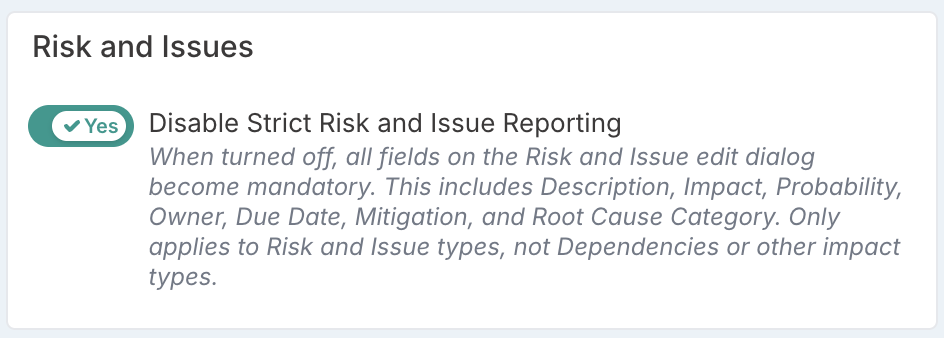
Important: The flag uses inverted logic:
When Disable Strict Risk and Issue Reporting is On (default), strict mode is disabled and fields become optional.
When Disable Strict Risk and Issue Reporting is Off, strict mode is enabled and all mandatory fields must be completed before saving.
Behaviour by flag state:
Flag state | Strict mode | Field behaviour |
On (default) | Disabled | Users can save Risks and Issues with incomplete information. |
Off | Enabled | Users must complete all mandatory fields before saving a Risk or Issue. |
Impact types affected
Strict validation applies only to Risks and Issues.
All other impact types are unaffected by this setting.
Impact Type | Strict validation applied? |
|---|---|
Risk | Yes |
Issue | Yes |
Dependency | No |
Change | No |
Decision | No |
Lessons Learned | No |
Benefit | No |
Variation | No |
Schedule | No |
Relationship | No |
Summary
Use Strict Risk and Issue Management when you want to ensure that Risks and Issues are recorded with complete and consistent information. This improves data quality, supports stronger governance, and helps teams manage ownership, mitigation, and follow-up more effectively.